

Native American culture is prevalent throughout Montana, with twelve tribes residing locally. There are seven Indian reservations in Montana, which are also home to the Little Shell Tribe of Chippewa Indians.
Each of the reservations in Montana has a unique history, economy, and points of interest that allow the tribes to preserve their culture.
Guide to The Reservations of Montana
There is a total of seven reservations in Montana, these include; Flathead Reservation, Blackfeet Reservation, Rocky Boy’s Reservation, Fort Belknap Reservation, Fort Peck Reservation, and the Northern Cheyenne Reservation. In addition, Montana recognizes the Little Shell Chippewa Band as part of the indigenous community.
Montana Reservations Map
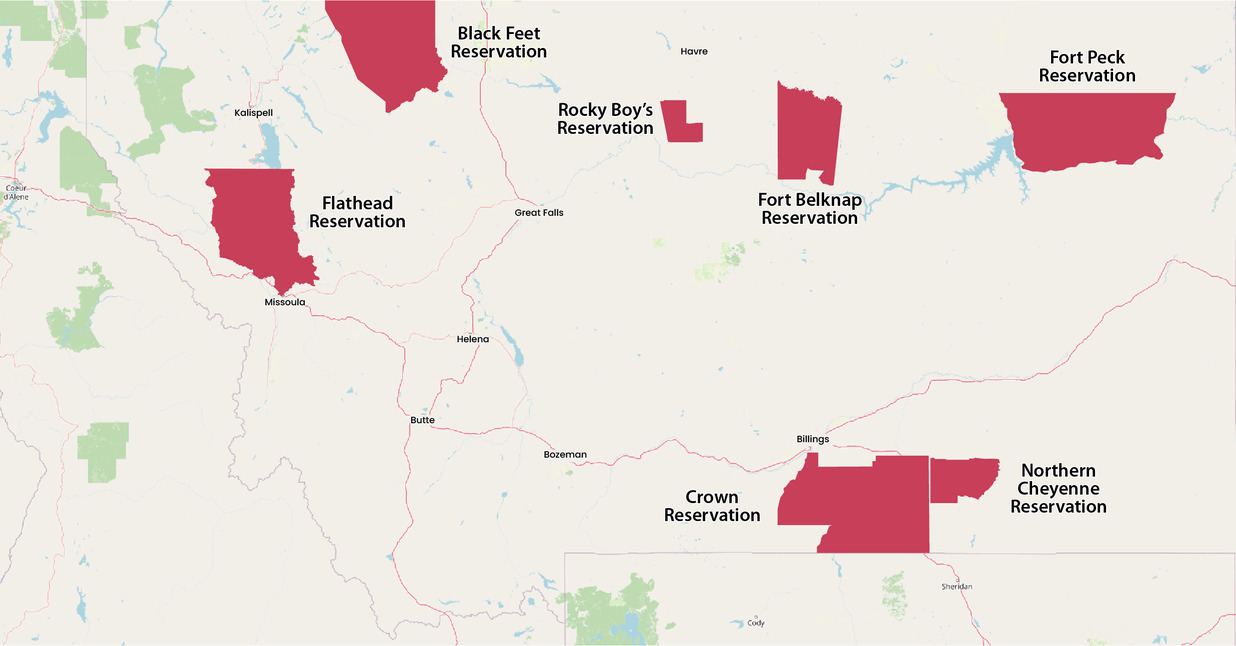
The 7 Reservations in Montana
1. Flathead Reservation

The Flathead Indian Reservation, which is headquartered in Pablo, is home to the Bitterroot Salish, Pend d’Orielle, and Kootenai tribes of Montana.
Together, there are approximately 7,753 enrolled members of these Tribes, 5,000 of which live on or near the Flathead Reservation across its many communities, including Ronan and Pablo.
The Salish people describe themselves with the name “Sqelix” while the Kootenai call themselves “Ktunaxa”. Prior to white settlement, these Tribes inhabited the land that would become western Montana.
The reservation encompasses more than 1.2 million acres and lies between the cities of Missoula and Kalispell, north of Interstate 90. The landscape surrounding the reservation features grassy valleys and snow-capped mountains.
The History of Flathead Reservation
The Flathead Reservation was first formed in the Hellgate Treaty of 1855, where the three Tribes surrendered 12 million acres of land in Montana and Idaho, and in return, 1.2 million acres were reserved for the Flathead in the Jocko Valley.
The initial treaty included a clause declaring that the President would later decide if the land would be used by the Flathead or by American settlers. The leader of the Bitterroot Salish likely believed that his people would be permitted to remain in the valley permanently, and so signed the treaty.
Under the protection of the treaty, the Tribes continued to hunt in the forests surrounding the reservation. However, a small hunting party of Pend d’Oreilles was murdered by a game warden in the Swan Valley Massacre in 1908.
Unable to hunt outside the reservation, the Tribes became dependent on government aid for survival.
Flathead Reservation Today
Today, timber industry sales provide the main source of income for the Tribes of the Flathead Reservation, and there are also revenues paid to them through the co-license for the Kerr Dam facility.
Another prominent source of income is a full-service resort that the Tribes run in Polson, which includes a casino managed by a tribal corporation called S&K Gaming.
A